Skip to content
Baiding Chen

Baiding Chen

M.S. Student in Automated Science · Carnegie Mellon University

I am an M.S. student in Automated Science at the School of Computer Science, Carnegie Mellon University.

My research sits between AI and the life sciences: I build LLM agent systems that turn scientific intent into executable laboratory automation, and develop deep learning methods for biological data.

Before CMU, I received my B.Sc. in Biomedical Statistics from Xi'an Jiaotong-Liverpool University (XJTLU).

Research Interests

News

Selected Publications All publications →

Research Projects All projects →

Oct 2025 – Present· Researcher (co-first author)

AutoBioLab: Multi-Agent LLM System for Automated Biology Labs

Carnegie Mellon University · Prof. Min Xu & Prof. Rebecca E. Taylor

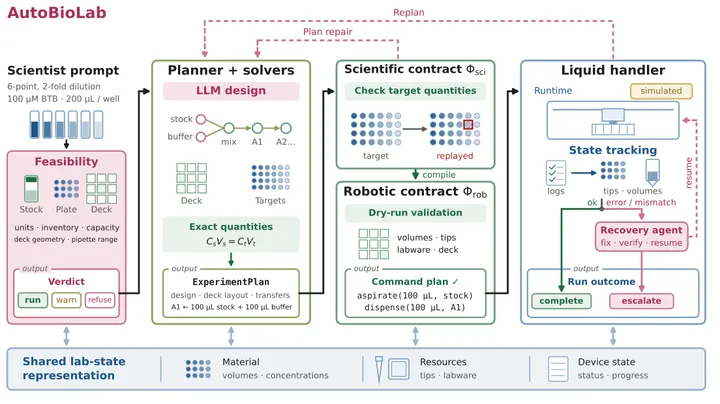
An LLM agent framework that takes a scientist's intent all the way to executed experiments on liquid-handling robots, with checks before a run and automatic recovery when something goes wrong.

  • Designed a multi-agent framework covering experiment planning, protocol verification and real-time monitoring across multiple liquid handlers.
  • Built pre-execution validation and a hybrid rule + LLM tool-calling recovery agent that repairs failures during a run.
  • Created a 48-task real-experiment planning suite and a 96-scenario fault-injection simulator; benchmarked against 8 LLMs and agent baselines.
  • LLM Agents
  • Laboratory Automation
  • Liquid Handling
Jul 2026 – Sep 2026· Remote Research Assistant (co-author)

OSWorld-Science: Computer-Use Agents on Scientific Software

Northeastern University · Dr. Tianyu Liu & Prof. Wengong Jin

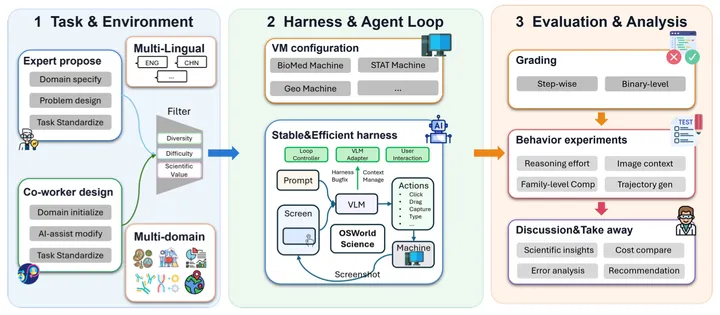
A benchmark that tests whether AI agents can operate real scientific software on a virtual desktop. I built its chemistry domain, the largest and hardest part of the benchmark.

  • Built the chemistry task set, 43 tasks (about 30% of the benchmark), each with an automatic RDKit grader for SMILES, InChIKey and stereochemistry.
  • Connected the tasks to the OSWorld agent harness and evaluated frontier models.
  • Chemistry turned out to be the hardest domain; the best model solved only about 44% of its tasks.
  • Computer-Use Agents
  • Benchmark
  • Cheminformatics
Oct 2025 – Jul 2026· Research Assistant (first author)

CryoPASS: Domain Adaptation for Cryo-ET Segmentation

Carnegie Mellon University · Prof. Min Xu

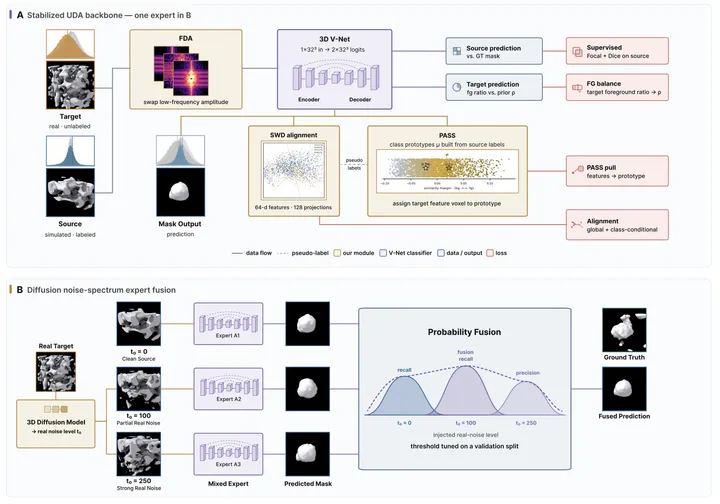
Segmenting proteins in real cryo-electron tomograms without any real voxel labels, by adapting models trained on simulated data while avoiding the collapse that sparse foregrounds usually cause.

  • Trained 3D protein segmentation models on simulated cryo-ET and adapted them to real tomograms with no real labels.
  • Developed a collapse-free adaptation method (foreground-balance loss, Fourier style alignment, prototype pseudo-labels) that beats the best baseline by 1.8× and reaches 78% of the fully supervised upper bound.
  • Built a benchmark of 9 baselines across backbones and datasets; our method was also the most stable across random seeds.
  • Cryo-ET
  • Domain Adaptation
  • 3D Segmentation

Education Full CV →

  1. Aug 2025 – Present
  2. Sep 2021 – Jul 2025

Recent Writing All posts →